The situation
Everything Strike did before lending was self-paced. Customers bought bitcoin when they wanted, sent payments when they wanted, and withdrew when they wanted. Nothing in the product had ever required an action by a deadline, and nothing had penalised them for not noticing.
Lending changed that orientation. A loan has an active health state that moves on its own, due to the volatility of the collateral. At 70% loan-to-value the customer has 72 hours to act. At 85%, there is no window at all. A missed payment starts a ten-day clock.
Explaining loan dynamics was the easier part of the task. The harder part was introducing a category of behaviour that Strike’s customers were unaccustomed to, where missing it could mean their bitcoin was sold while they slept.
A second constraint existed, but was unmentioned. Customers had watched Celsius, BlockFi and Voyager fail in 2022, each of them by lending out customer assets, so anything written about custody would be read against that memory by people who had lost money.
The strategy
I designed the content approach from an entire lifecycle perspective rather than screen by screen.
Origination is the only moment a customer is fully captive to the experience, so the intro screens had to establish the persistent attention expectations, and connect the in-app slider they were dragging to the price at which they would be called. The LTV Tracker then gave that obligation a permanent home in the app’s Cash tab, visible whether or not anything was wrong, so the mental model included an ongoing position rather than a completed transaction.
Each escalation in the loan’s state got a name, a required action and a deadline, worded identically in the app, the push notification, the email and the help centre. I wrote the outbound layer alongside the in-product strings for a completely aligned experience, no matter what surface the customer touched.
Selected work
Before the loan. Origination intro screens establish that this is an ongoing position, and link out to the FAQ for anyone who wants to review the thresholds before committing.
During. The LTV Tracker sits on the app’s Cash tab as a glanceable state. Tapping it opens the Loan Center.
On escalation. A push notification communicates the state, the action and the deadline in the characters a lock screen will show.
In parallel. An email carries the same three facts plus the expanded details that will not fit.
To act. Loan Center, then “Resolve margin call”, then “Pay cash” or “Add bitcoin”.
To understand. The help centre and Learn content covers thresholds, windows, loan dynamics, what happens if you do nothing, and the tax consequence.
The content system is comprised of six surfaces, with one underlying state machine behind them. The customer decides how much they want to understand, but not whether they were told. Writing all six layers meant the words for a given state stayed identical everywhere, which matters more here than anywhere else in the product. Someone comparing a notification against a screen at 3am should not have to work out whether “margin call” and “collateral warning” mean the same thing.
- Select loan type: Choose between “Monthly Interest” (interest paid monthly, principal paid at maturity) or “Payment at Maturity” (interest and principal paid at maturity).
- Set loan amount: Adjust the slider to select your desired loan amount, which affects the required collateral and interest cost.
- Set collateral amount: Adjust the slider to set your collateral amount. Remember, adding extra collateral reduces the bitcoin prices at which margin calls and liquidations occur.
- Choose payment source: Select your preferred source for automatically paying your monthly interest (if applicable) and maturity payment.
- Enable notifications: Ensure notifications are enabled for the Strike app to receive important loan updates.
- Preview loan details: Review your loan configuration.
- Review and sign agreement: The loan agreement will be emailed to your account for review. If you accept, return to the Strike app to sign your screen and tap “Initiate loan.”
Step-by-step explanations should be informed by the weight of those steps. Step 3 could have said “set your collateral amount” and stopped, however, adding the consequence turns a slider into a decision about future risk. Step 5 is a named and numbered step that is presented as essential because the escalation system is worthless to a customer with notifications switched off. Every quoted string is in-product copy I also wrote, which has corresponding FAQ entries in the help centre.
| Trigger | LTV | Window | Result |
|---|---|---|---|
| Margin call | 70% | 72 hours | Add collateral or repay to 65% |
| Liquidation | 85% | None | Partial sale to return LTV to 65% |
| Missed monthly payment | n/a | 10 days | Collateral sold to cover overdue amount |
| Missed payment at maturity | n/a | 10 days | Loan closed, remainder returned in 1 business day |
Four ways to lose collateral, each with its own window and remedy. Long, bulky prose can bury that, and a borrower under stress cannot parse text blobs. The table was also the source of truth the notification strings were written against, which is why the vocabulary matches across surfaces.
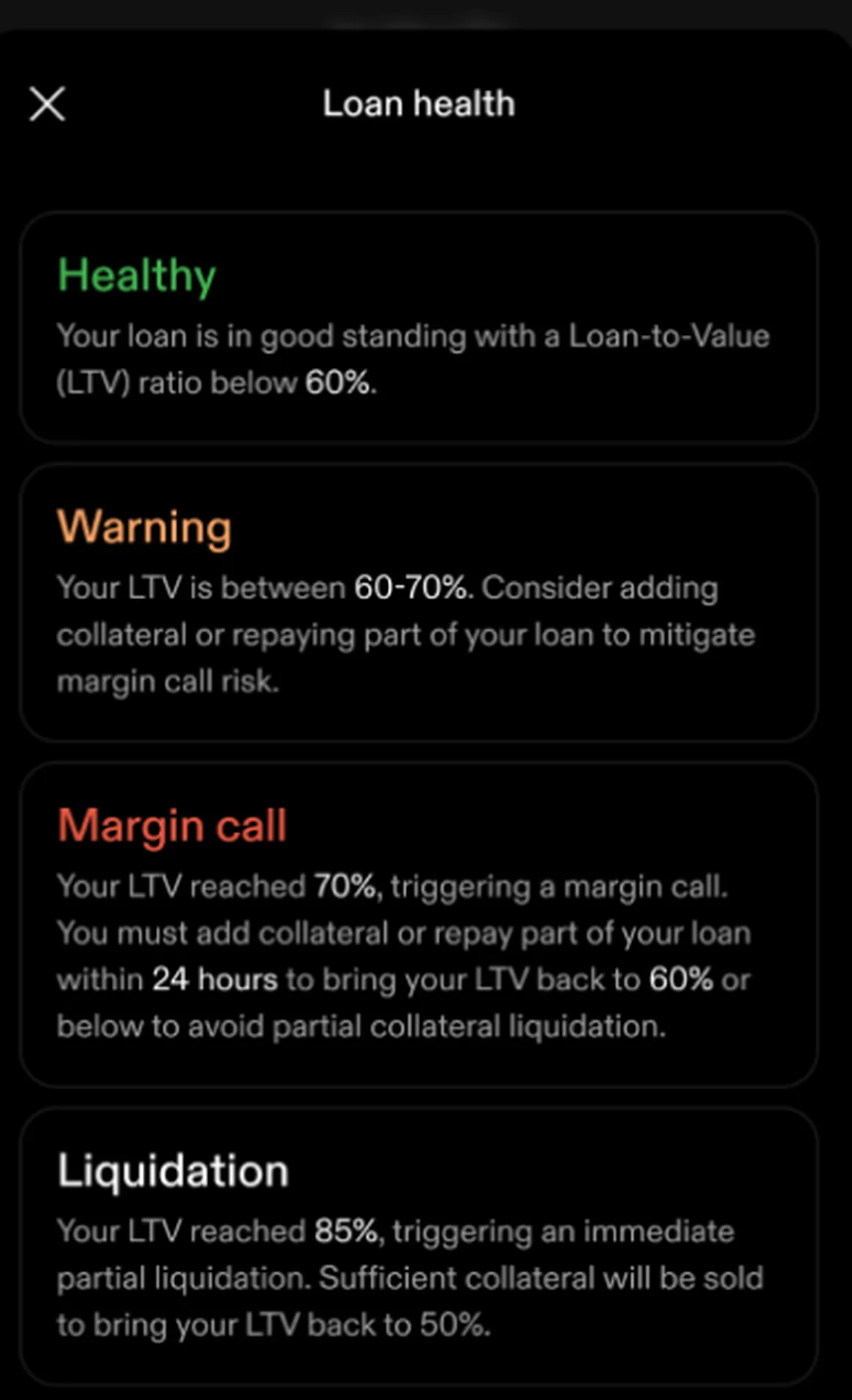
Colours and logical progression shows the reader what to expect at each stage of their loan’s health. Warning sits between 60 and 70% and asks nothing of the customer. It exists only to tell someone they are drifting toward a threshold that will require action.
That screen is a condensed explanation of the product. A margin call is a message you send after the customer has a problem, whereas the warning is the one that stops them having it.
Note the thresholds here differ from the published table above, which reflects Strike’s current terms. The window was 24 hours in this build and is 72 hours now.
Strike partners with trusted capital providers to deliver bitcoin-backed loans with the best possible rates and terms. When you open a loan, your bitcoin collateral is held by Strike or transferred to one of our trusted capital providers, where it is securely held and not further re-hypothecated. This means your bitcoin collateral is never lent-out, shorted, or transferred to any other external third party.
This was among the most important pieces of content for the launch. Collateral can be transferred to funding partners, so a flat “no rehypothecation” would have been inaccurate, and vagueness was not an option because this was the exact thing the audience was reading for after 2022. The resolution was to name the transfer openly, establish trust and consistency, and then translate all of that into the one sentence a non-specialist needs.
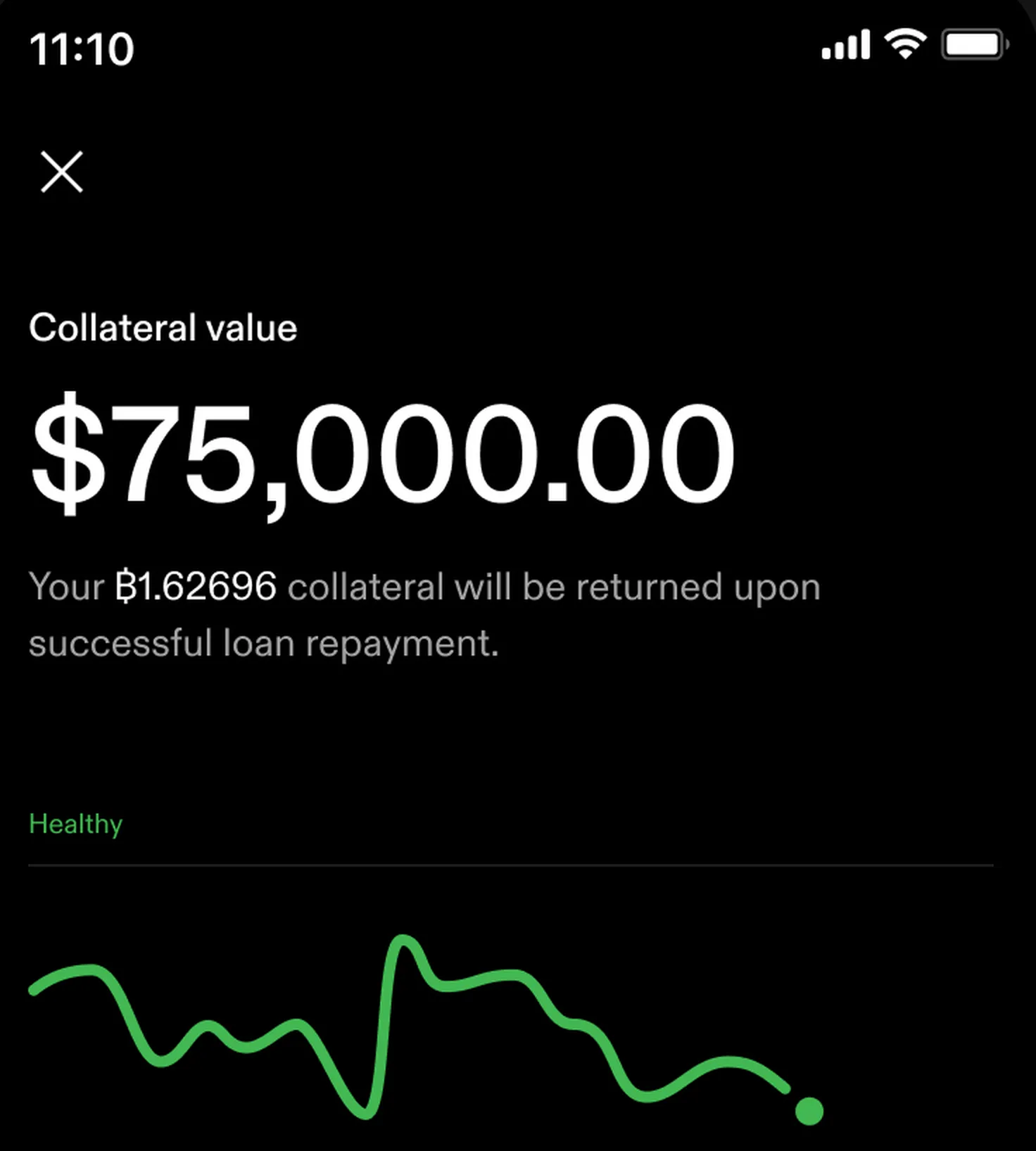
A borrower checking their loan status wants reassurances. This is delivered through colour, line charts, hero value amounts and supporting copy. The sentence under the hero answers the question they actually have, which is whether they are getting their bitcoin back.
“Will be returned upon successful loan repayment” survived legal because it is conditional and precise.
Outcome
$10M in bitcoin-backed loans within 48 hours of launch, across a flow whose copy I owned end to end.
Strike launched on 6 May 2025 and the figure was announced the following day. At launch the product ran from $75,000 to $2,000,000 with a 50% maximum initial LTV, so that number represents a small group of customers who read the terms carefully before pledging six figures of bitcoin to a product that could call on them at 3am.
Source: Strike hits $10m in BTC-backed loans two days after launch, crypto.news, 8 May 2025.
Written as Senior Content Manager at Strike. Strike has continued to develop the product since 2025, including a line of credit, and the marketing pages have been rewritten around it. Exhibits are drawn from the July 2025 page and the lending help centre.